
Industrial heritage sites are important carriers of technical knowledge, social memory, and regional identity, yet many of them face deterioration, underuse, or limited public visibility. Within the broader aims of HI-EURECA-PRO, digital transformation can support the preservation and reinterpretation of such sites by improving documentation, access to knowledge, and cross-sector collaboration. The Digital Transformation Hub is designed precisely as a space for sharing resources, practices, and insights related to digital transformation in cultural, industrial, and mining heritage. In this context, digital tools should not be seen as ends in themselves, but as practical means of strengthening conservation, education, sustainability, and stakeholder engagement around industrial heritage.
The preservation of industrial heritage increasingly depends on the ability to connect physical conservation with digital methods of documentation, interpretation, and knowledge exchange. HI-EURECA-PRO situates this challenge within a broader European effort to link heritage-based innovation with sustainable development, research excellence, and regional collaboration, particularly regarding cultural, industrial, and mining heritage.
Industrial heritage often includes complex sites, technologies, and material traces that are difficult to maintain, interpret, and communicate through traditional methods alone. Digital transformation can strengthen preservation practice by enabling more systematic recording of assets, better organisation of heritage knowledge, and wider access to information for researchers, students, institutions, and local communities. This is closely aligned with the purpose of the HI-EURECA-PRO Digital Transformation Hub, which has been developed as a platform for gathering, sharing, and promoting knowledge on digital transformation with a particular focus on heritage domains In practical terms, digital transformation supports industrial heritage preservation in at least three ways. First, it improves documentation and visibility through digital repositories, research outputs, training materials, and other structured resources that can support long-term knowledge retention. Second, it facilitates collaboration across higher education institutions, industry, and society by making expertise and examples more accessible. Third, it helps connect preservation with broader innovation agendas, including sustainability, material responsibility, and digital readiness. These functions reflect the broader goals of HI-EURECA-PRO, which seeks to build regional innovation ecosystems on heritage and to strengthen collaboration between higher education and the heritage sector.
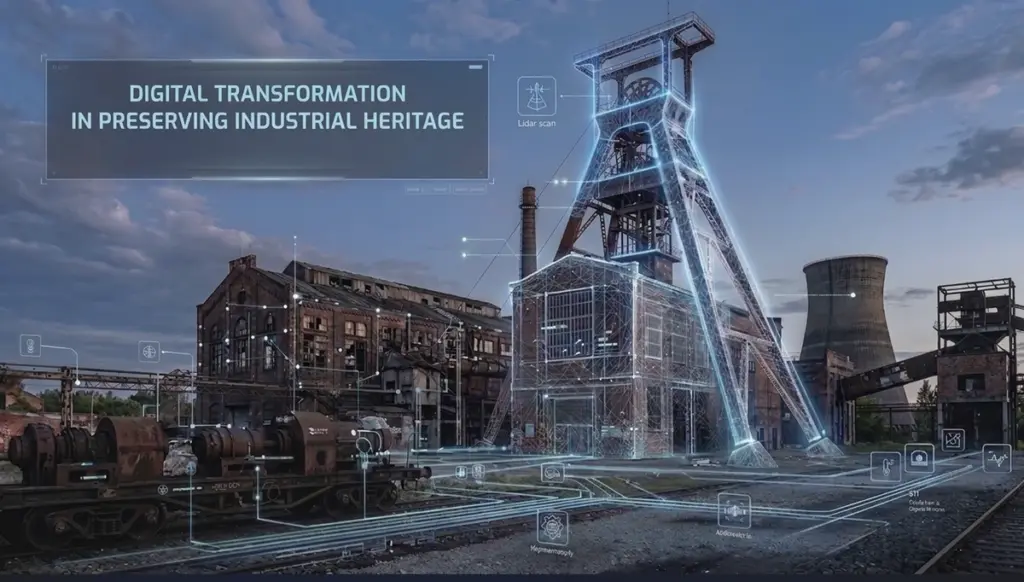
Digital transformation has an increasingly important role in preserving industrial heritage because it strengthens documentation, supports knowledge exchange, and broadens access to heritage-related expertise. For initiatives such as HI-EURECA-PRO, the challenge is not simply to digitise heritage, but to use digital methods in ways that reinforce sustainability, collaboration, and long-term public value. A careful integration of digital tools into preservation practice can therefore help industrial heritage remain both protected and meaningful in the future.