
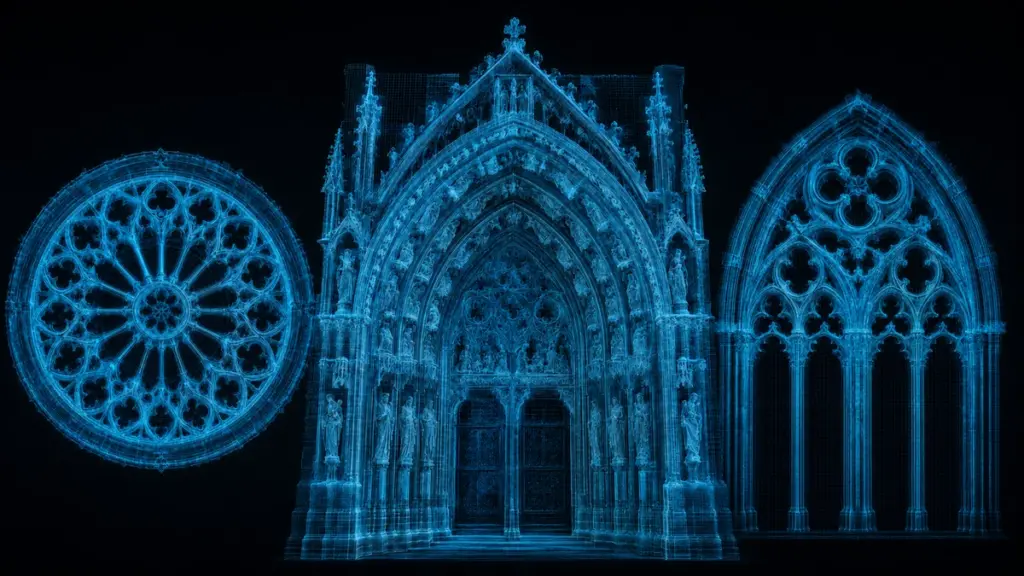
The 2019 fire at Notre-Dame de Paris was a near-catastrophe with one quiet stroke of luck: years earlier, art historian Andrew Tallon had laser-scanned the building, recording around a billion points. That point cloud became an indispensable reference for the reconstruction that returned the cathedral to the public in December 2024 (GPS World).
In July 2025 the story entered a new chapter. Microsoft, the French Ministry of Culture and the Paris heritage-tech firm Iconem signed an agreement to build a centimetre-precise digital twin of the cathedral from high-resolution photography, drone imagery and LiDAR, with the finished model to be donated to the French state and displayed in the future Musée Notre-Dame de Paris (Euronews, quoting Microsoft president Brad Smith’s announcement; Africanews; designboom). The same partners had previously reconstructed St Peter’s Basilica from some 400,000 images.
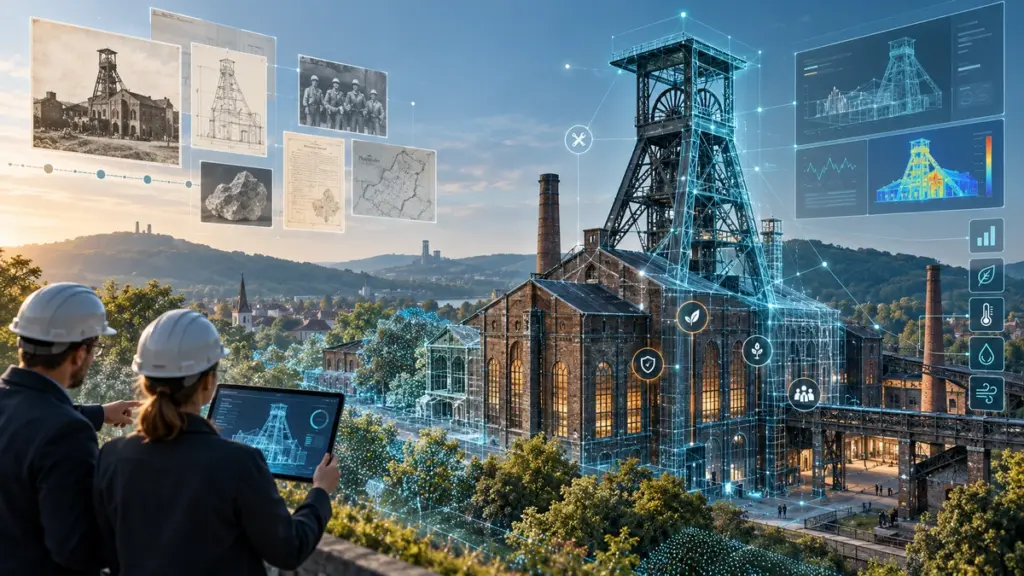
A digital twin is more than a pretty render. It is a structured, updatable replica that lets conservators monitor cracks, simulate stress, and let the public explore spaces they could never physically reach. For heritage at risk, from climate stress to conflict, the twin is becoming a form of insurance written in pixels. It is precisely the toolkit HI-EURECA-PRO partners are adapting for cultural, industrial and mining heritage across Poland, Greece and Romania.
Notre-Dame is only the most visible node in a fast-spreading practice. The same Microsoft–Iconem “Culture AI” effort has already twinned sites from Mont-Saint-Michel to Ancient Olympia in Greece — a reminder that the method speaks as directly to a partner country’s classical heritage as to a French cathedral (designboom). Just as importantly, twinning is increasingly deployed not only to recover what has been lost but to protect what is still standing: in war-damaged Ukraine, virtual-twin and satellite-data workflows have been used to assess destruction and plan reconstruction in the Chernihiv region (Dassault Systèmes), while conservators at monuments such as York Minster and St Patrick’s Cathedral in New York use detailed models to track how pollution, light and weather wear a building over time (Church Heritage Europe). The underlying lesson is sobering and empowering at once: a digital twin is most valuable before catastrophe, captured while the original is whole — which is exactly why documenting today’s heritage, however ordinary it may seem, is an act of foresight rather than nostalgia.