
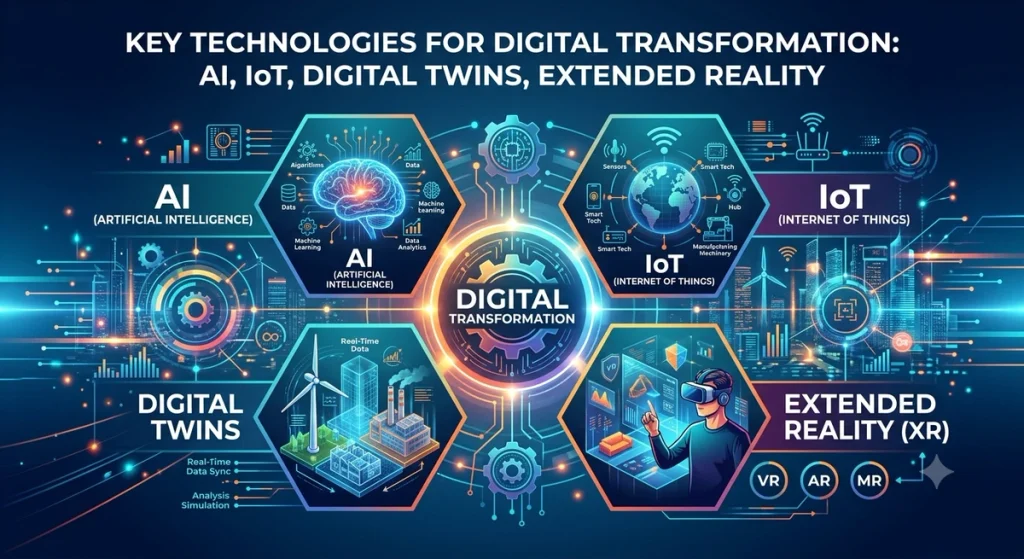
Artificial intelligence (AI), the Internet of Things (IoT), digital twins and extended reality (XR) are increasingly important components of digital transformation. Although each technology has distinct functions, their combined application can support more effective monitoring, analysis, decision-making and communication across cultural heritage, industrial heritage and mining heritage contexts. IoT devices can collect data from physical assets and their surroundings; AI can assist in identifying patterns and anomalies; digital twins can provide dynamic digital representations of sites, structures or processes; and XR can enable immersive forms of interpretation, training and stakeholder engagement. This article outlines the complementary roles of these technologies, considers their potential contribution to sustainability and heritage management, and highlights key requirements for their responsible implementation.
Digital transformation is not simply the conversion of analogue information into digital form. It involves changes in how organisations collect and interpret data, manage assets, communicate knowledge and make decisions. Within heritage-related fields, these changes may affect documentation, conservation, maintenance, risk assessment, education and public engagement. AI, IoT, digital twins and XR are among the technologies most frequently associated with this transformation. Their value does not lie solely in their individual capabilities. More significant opportunities arise when they are integrated into coherent systems that connect physical assets, digital information and human expertise.
Artificial intelligence: supporting analysis and decision-making
AI refers to computational methods that can perform tasks commonly associated with human intelligence, including pattern recognition, classification, prediction and language processing. In heritage and industrial contexts, AI may support the analysis of large or complex datasets that would otherwise require considerable time and specialist effort.
Potential applications include the identification of changes in images or sensor readings, the classification of archival resources, predictive maintenance and the detection of unusual operating or environmental conditions. AI may also improve access to digital collections by supporting search, transcription, translation and metadata generation. However, AI-generated outputs should not be treated as automatically objective or authoritative. Their reliability depends on the quality, relevance and representativeness of the underlying data. Expert review, transparent documentation and clearly defined responsibilities remain essential, particularly where analytical results influence conservation or safety-related decisions.
The Internet of Things: connecting assets and environments
The IoT consists of connected sensors, devices and systems that collect and exchange data. In heritage management, IoT technologies can support the continuous or periodic observation of environmental and structural conditions. Relevant measurements may include temperature, humidity, vibration, movement, air quality or energy consumption, depending on the characteristics of the asset and the purpose of monitoring.
For industrial and mining heritage, IoT systems may help organisations understand how buildings, machinery, infrastructure and environmental conditions change over time. This can support condition-based maintenance, improve resource efficiency and provide earlier indications of deterioration or abnormal behaviour.
The introduction of connected monitoring also creates technical and organisational responsibilities. Systems require appropriate maintenance, calibration, cybersecurity measures and data-management procedures. Monitoring strategies should therefore be based on clearly identified needs rather than on the indiscriminate collection of data.
Digital twins: linking physical and digital assets
A digital twin is a digital representation of a physical asset, system or process that can be updated using information from its real-world counterpart. Unlike a static three-dimensional model, a digital twin may incorporate current or historical data, operational information and analytical models.
In heritage contexts, digital twins can bring together geometric surveys, archival documentation, material information, inspection records and sensor data. This integrated environment may support condition assessment, maintenance planning, scenario analysis and interdisciplinary collaboration. It can also help document changes to an asset throughout its lifecycle.
The effectiveness of a digital twin depends less on visual complexity than on the quality and organisation of its information. Clear data structures, interoperability and long-term governance are therefore important. Before developing a digital twin, organisations should determine what decisions it is expected to support, which data are required and how the system will remain usable over time.
Extended reality: creating immersive access and interaction
XR is an umbrella term covering virtual reality, augmented reality and mixed reality. These technologies combine physical and digital environments in different ways, supporting immersive visualisation and interaction.
XR can provide access to locations that are remote, fragile, hazardous or no longer fully preserved. It may be used to reconstruct historical settings, explain industrial or mining processes, support technical training and present different phases in the development of a site. Augmented reality can add contextual information to a physical visit, while virtual reality can create an entirely digital experience.
Effective XR applications require more than visual impact. They should be historically and technically credible, accessible to intended audiences and designed around clear educational or operational objectives. Where reconstructions include uncertain or hypothetical elements, these should be distinguished from evidence-based information.
Integrating the technologies
The greatest potential emerges when these technologies are treated as complementary components. IoT sensors can collect information from a physical asset; AI can analyse incoming data; a digital twin can organise and visualise the results; and XR can make selected information accessible through immersive interfaces.
Such integration may improve the understanding of complex sites and support more timely interventions. It may also strengthen communication between heritage professionals, engineers, researchers, public authorities and local communities. Nevertheless, technological integration should remain proportionate to organisational capacity and user needs. Projects should consider data quality, interoperability, cybersecurity, accessibility, ethical responsibilities and long-term maintenance from the outset. Energy use and the environmental costs of digital infrastructure should also be assessed if digital transformation is intended to contribute meaningfully to sustainability.