
European policies increasingly connect digital transformation with environmental sustainability, social inclusion and economic resilience. The European Green Deal, the Digital Decade Policy Programme 2030 and the New European Bauhaus provide an important strategic context for innovation in cultural, industrial and mining heritage. Together, these initiatives encourage climate action, circular use of resources, sustainable digital infrastructure, improved digital skills and inclusive access to cultural knowledge. European policy also supports the digitisation and preservation of heritage through the common European data space for cultural heritage. For heritage organisations, this framework creates opportunities to use digital technologies in conservation, monitoring, adaptive reuse, education and public engagement. At the same time, projects must consider their environmental footprint, long-term maintainability, accessibility and value to communities.
The digital and green transitions are closely connected within European policy. Digital technologies can support more efficient resource use, better environmental monitoring and wider access to knowledge. However, their implementation must also account for energy consumption, material demand, data governance and social inclusion.
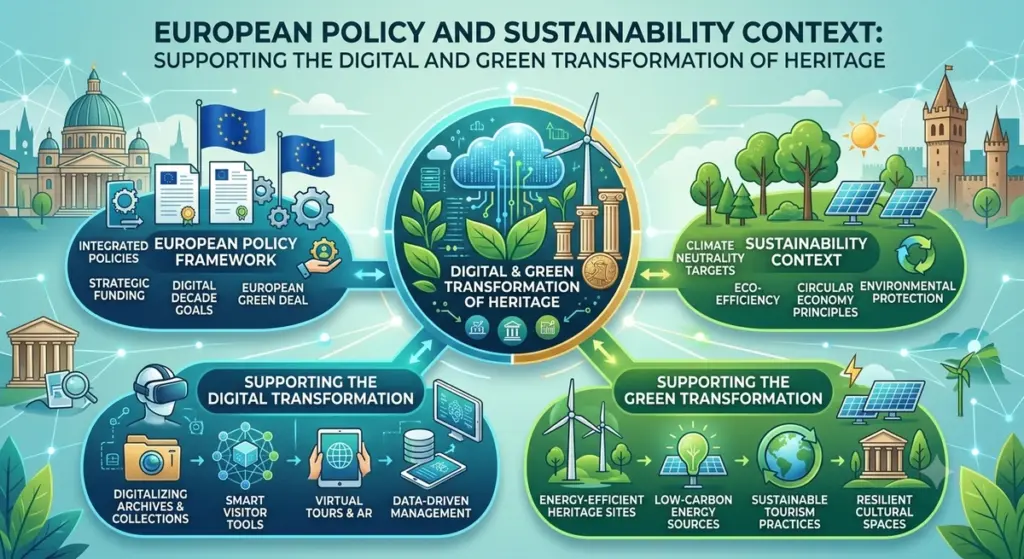
The European Green Deal establishes the EU’s broader direction towards a modern, resource-efficient and climate-neutral economy. The European Climate Law makes climate neutrality by 2050 legally binding and sets an EU target of reducing net greenhouse gas emissions by at least 55% by 2030 compared with 1990 levels. These objectives have direct implications for the management of buildings, infrastructure, industrial sites and post-mining areas.
The Digital Decade Policy Programme 2030 complements this agenda by promoting digital skills, secure and sustainable infrastructure, the digital transformation of businesses and the digitalisation of public services. Its human-centred approach emphasises that digital innovation should reflect European values, reduce exclusion and generate benefits for citizens and organisations.
For cultural, industrial and mining heritage, these priorities support the use of technologies such as smart monitoring, artificial intelligence, digital twins and extended reality. The common European data space for cultural heritage further encourages digitisation, digital preservation and the responsible sharing and reuse of heritage data. The New European Bauhaus adds a cultural and participatory dimension by linking sustainability with inclusion, quality of place and design. This approach is particularly relevant to the adaptive reuse and regeneration of historic buildings, industrial areas and mining landscapes, where environmental objectives must be balanced with cultural significance and community needs.
The policy priorities outlined above are also reflected in European funding programmes for research and innovation, where digital transformation, sustainability and cultural heritage increasingly intersect. Researchers, heritage organisations and technology providers can access a range of funding opportunities supporting the development, testing and implementation of innovative solutions for the digitisation, preservation, monitoring and sustainable management of heritage assets. To help identify the most relevant programme and call for proposals, we encourage readers to use our Funding Match AI tool, which can support the search for funding opportunities tailored to research and innovation projects combining digitalisation with the long-term sustainability of cultural, industrial and mining heritage.