
Here is a paradox at the heart of digital heritage. The more easily we copy, stream and remix cultural objects, the harder it becomes to answer a simple question: is this real, and where did it come from? As 3D models, scans and AI-restored images proliferate, provenance the documented chain of origin and custody becomes as important for digital assets as it always was for the originals.
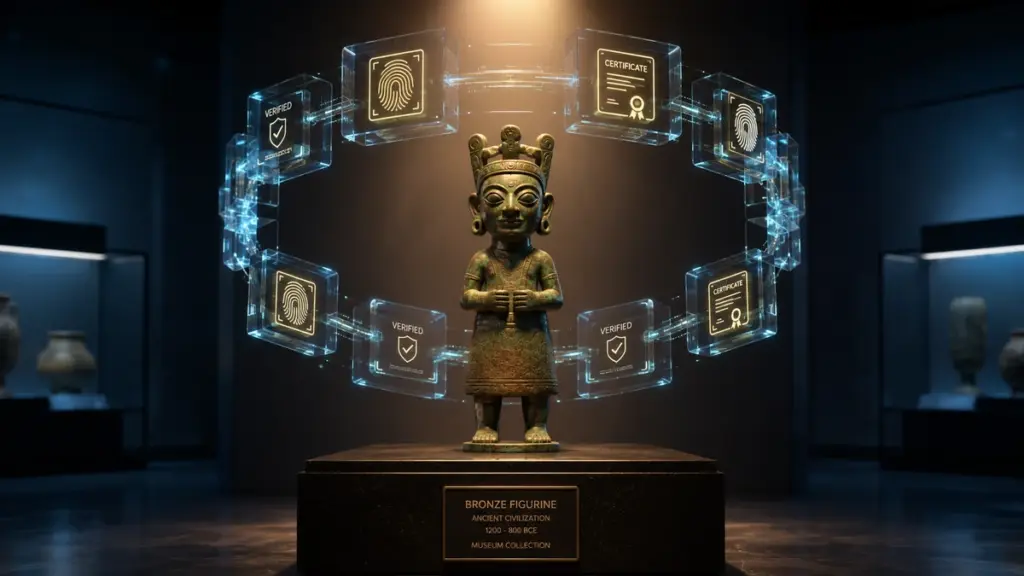
This is where blockchain quietly enters the heritage conversation. By recording an object’s identity and history in a tamper-resistant ledger, the technology can underpin verifiable authenticity and ownership. Marzouk, Labib and Metawie (2024) survey concrete applications of blockchain in maintaining heritage buildings, while Zhang, Taib and Taib (2025), in a study of 575 survey responses analysed with structural equation modelling, find empirically that blockchain/NFT authentication indirectly improves heritage conservation effectiveness by strengthening “digital authenticity.” Spennemann (2026) reaches the same destination from the curatorial side, recommending “blockchain-secured metadata” among the documentation standards that protect collections against future challenges to authenticity.
Poland offers a vivid live example. In the ARCHIV3 project (2024), Bank Pekao — working with the Aleph Zero blockchain and Degen House — created museum-grade 3D scans of masterpieces by artists such as Jan Matejko and Stanisław Wyspiański, minted them as NFTs for provenance, and archived the files in the Arctic World Archive in Svalbard for long-term safekeeping (Aleph Zero; The Art Newspaper).
The enthusiasm comes with caveats worth stating plainly. Zhang and colleagues (2025) flag that the energy footprint of blockchain and immersive rendering remains “poorly quantified,” urging life-cycle assessment of GPU and processing costs. A sustainability concern echoed by the UNESCO Recommendation on the Ethics of AI, which asks AI actors to favour energy- and resource-efficient methods. There are governance questions too: who controls the ledger, and how do we avoid turning shared culture into speculative assets? The emerging consensus is to treat authentication as a means to protect public trust, not to financialise memory. For HI-EURECA-PRO, the message is balanced optimism: provenance technology can make digital heritage more trustworthy and more reusable, provided we deploy it deliberately, transparently and green.
References
- Marzouk, M., Labib, N., & Metawie, M. (2024). Blockchain technology applications in maintaining heritage buildings. Journal of Cultural Heritage, 67, 62–72. https://doi.org/10.1016/j.culher.2024.02.005
- Spennemann, D. H. R. (2026). Now more than ever: the role of museum and archival objects in an age of generative artificial intelligence. Collection and Curation, 45(1), 14–20. https://doi.org/10.1108/CC-04-2025-0020
- Zhang, W., Taib, N., & Taib, M. (2025). Reimagining cultural heritage conservation through VR, metaverse, and digital twins: An AI and blockchain-based framework. PLOS ONE, 20(11), e0335943. https://doi.org/10.1371/journal.pone.0335943