
For two days in June, Warsaw became the capital of Europe’s digital memory. Europeana 2025 – Preserve, Protect, Reuse, the flagship conference of the common European data space for cultural heritage, was held on 11–12 June 2025 at the POLIN Museum of the History of Polish Jews, under the patronage of the Polish Presidency of the Council of the EU and in partnership with Poland’s Ministry of Culture and National Heritage and the National Institute of Cultural Heritage (Europeana).
It was a substantial gathering: more than 70 sessions, keynotes, panels, hands-on workshops and the occasional social moment (yes, a silent disco included), delivered in a hybrid format that welcomed an international audience both on site and, free of charge, online (full programme). The data space itself was the red thread running through all of it.
The intellectual spine came from three keynotes: Birgitte Aga, Dr Julia Noordegraaf and Jakub Wróblewski followed by video provocations and panel debates (programme details). Opening contributions came from Poland’s Minister of Culture and National Heritage, Hanna Wróblewska, and from the European Commission’s Rehana Schwinninger-Ladak (DG CONNECT). A high-level Policy Forum Preserving cultural heritage: Protecting heritage at risk and enhancing cybersecurity, convened policymakers for a keynote by Liz Jolly (British Library) and an interview with Ukraine’s Deputy Minister of Culture, Anastasia Bondar, before closing with a Call to Action titled Ready for the future: Building preparedness in digital cultural heritage (conference recordings).
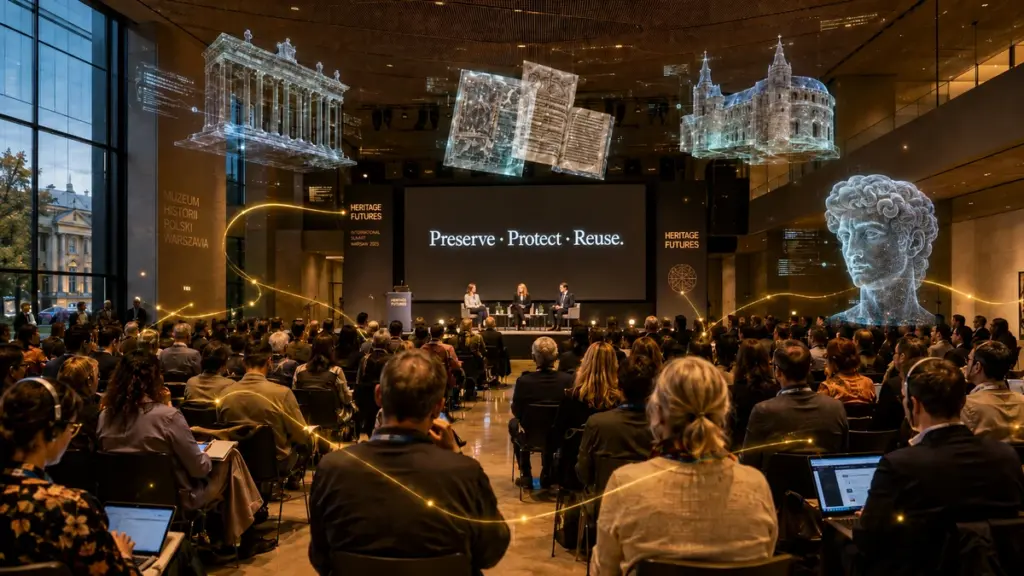
If the keynotes set the vision, the workshops showed the tools: detecting bias with AI, working with 3D, the Europeana Academy, participatory approaches and ARK persistent identifiers. Recurring threads tied the programme to the wider moment: 3D digitisation toward the EU’s goal of capturing every at-risk monument, sustainable cultural tourism, and a particularly poignant panel on safeguarding heritage in times of war (conference takeaways).
For HI-EURECA-PRO, the agenda reads like a mirror of the project’s own: 3D capture, reuse, capacity-building and heritage at risk, convened, fittingly, in one of the alliance’s widening countries. And hovering over the proceedings was the next milestone to watch: the data space’s Strategy 2025–2030, still in preparation, which the sector expects to chart the course to the end of the decade.